Vacation Rental Inventory Checklist: What to Stock, Track, and Recheck Between Guests
A vacation rental inventory checklist is not a shopping list you write once and forget. It is an operating standard: the agreed answer to what belongs in each property, how much of it, and what has to be verified between guests. This guide walks through how to set standards per property, a practical room-by-room checklist, the items hosts forget most often, and how to separate every-turnover checks from periodic audits.
What a vacation rental inventory checklist actually does
A good inventory checklist answers one question reliably: is this property complete right now? It is the difference between hoping the kitchen still has a corkscrew and knowing it does before a guest arrives at 4pm.
The first useful distinction is between permanent inventory and consumables. Permanent inventory is what stays with the property across stays: pots and pans, place settings, glassware, linens, towels, small appliances, remotes, furniture, hair dryers, and tools. It is not consumed — it is used, damaged, taken, or worn out.
Consumables are what each stay uses up: toilet paper, paper towels, soap, shampoo, dish detergent, laundry pods, coffee, filters, trash bags, sponges, and light bulbs. These do not need condition tracking; they need a replenishment level.
Mixing the two on a single list is one reason inventory checklists tend to fall out of use. Permanent items are counted and inspected. Consumables are restocked. They belong in the same standard but in different columns.
Before you make the list: set standards by property
Write the standard before you write the checklist. A standard is what should be present when the property is guest-ready, defined per property rather than across your portfolio.
For each line in your standard, capture these fields:
- Property. Standards belong to an address, not to your business as a whole. A studio and a four-bedroom cabin should never share one list.
- Room or area. Kitchen, primary bedroom, hall bath, living area, laundry, deck. Grouping by area is what makes the list usable by a cleaner walking the property.
- Item. One specific, recognizable item per line. 'Glassware' is a category; 'wine glasses' is an item.
- Target quantity. How many should be present when the property is complete. This is your standard, and it is the number a turnover is measured against.
- Minimum or restock level. The point at which the item needs attention rather than the point at which it is gone. Consumables especially need a level, not just a target.
- Condition. For permanent inventory, note the expected state: unstained, unchipped, matched set, working. A present-but-unusable item is not inventory.
- Turnover verification. Mark whether the item must be checked every single turnover or only on a periodic audit. Without this flag, every checklist eventually becomes too long to complete honestly.
Why standards should vary by property
There is no universal correct quantity, and any checklist that gives you one is guessing about your business. The right standard depends on sleeping capacity, the number of bathrooms, how long the average stay runs, whether the property is positioned for families or couples, whether guests actually cook, how far the property is from a store, and how quickly you can get a cleaner back on site.
A remote cabin with weekly stays needs deeper backups than an in-town condo you can reach in fifteen minutes. A property marketed for family gatherings needs place settings and glassware sized to the group you advertise, not to the bed count alone.
Set the standard from your own occupancy patterns and positioning, then adjust it when reality disagrees with it. If you restock the same item mid-stay twice, the standard was too low.
Room-by-room vacation rental inventory checklist
Use this as a starting structure and set your own quantities per property. Items marked as consumables need a restock level; the rest are permanent inventory that needs a count and a condition.
Kitchen
A room with many small items, so it is easy to under-stock. Consider sizing place settings to your advertised capacity.
Permanent inventory
- Dinner plates, side plates, bowls
- Drinking glasses, wine glasses, mugs
- Forks, knives, spoons, serving utensils
- Pots, pans, lids, baking sheet, casserole dish
- Chef's knife, paring knife, cutting board
- Mixing bowls, colander, measuring cups and spoons
- Can opener, corkscrew, bottle opener, peeler
- Spatula, tongs, whisk, ladle, oven mitts
- Coffee maker, kettle, toaster, blender
- Food storage containers, pitcher, ice trays
- Dish rack, trash bin, recycling bin, dish towels
Consumables
- Dish soap and dishwasher detergent
- Sponges and scrub pads
- Paper towels
- Trash and recycling bags
- Coffee, filters, tea, sugar, salt and pepper
- Foil, plastic wrap, sandwich bags
Bedrooms
Linens often need to be judged on condition rather than count. A spare set per bed, kept off-property or in a locked closet, is one approach worth considering.
Permanent inventory
- Mattress protector and pillow protectors
- Sheet sets sized to each bed
- Pillows appropriate to bed size
- Blanket and duvet or comforter
- Extra blanket per bed
- Nightstand lamps and working bulbs
- Hangers, luggage rack, closet or dresser space
- Blackout curtains or blinds in working order
- Alarm clock or bedside charging access
- Full-length or dresser mirror
Consumables
- Nothing routinely consumed here beyond bulbs and batteries
Bathrooms
Bathroom shortages are easy for a guest to notice. Consider stocking per bathroom rather than per property.
Permanent inventory
- Bath towels, hand towels, washcloths per guest
- Bath mat and shower curtain or door in good condition
- Hair dryer
- Toilet brush and plunger
- Trash bin
- Tissue holder and towel hooks or bars
Consumables
- Toilet paper plus a visible backup supply
- Hand soap
- Shampoo, conditioner, body wash
- Facial tissue
- Bathroom cleaner
Living areas
Electronics and remotes are the quiet failure point. Verify that every remote works, not just that it is present.
Permanent inventory
- Seating sized to sleeping capacity
- Television and working remote
- Streaming device and remote
- Wi-Fi router accessible and network details posted
- Lamps and working bulbs
- Throw blankets
- Board games, books, or local guide
- House manual and emergency contact information
- Smoke and carbon-monoxide detectors in working order
- Fire extinguisher and first-aid kit
Consumables
- Remote batteries
- Replacement bulbs
Laundry and cleaning
This is where the cleaning team's needs live. If your cleaner has to bring supplies, your standard is incomplete.
Permanent inventory
- Iron and ironing board
- Drying rack
- Laundry basket or hamper
- Vacuum with working attachments
- Broom, dustpan, mop and bucket
- Bucket of cleaning cloths and rags
- Step stool
- Basic tool kit and spare batteries
Consumables
- Laundry detergent and stain remover
- All-purpose, glass, and floor cleaner
- Disinfecting wipes
- Gloves
- Vacuum bags or filters
Outdoor areas
Seasonal and weather-exposed, so condition checks matter more here than counts.
Permanent inventory
- Patio or deck seating and table
- Umbrella or shade structure
- Grill with clean grates and working ignition
- Grill tools and grill brush
- Outdoor lighting in working order
- Hose or outdoor spigot access
- Fire-pit seating and screen if offered
- Beach, pool, or trail gear if advertised
Consumables
- Grill fuel or propane
- Charcoal and lighter
- Bug spray or citronella if offered
The items hosts most often forget
These are inexpensive items that are easy to overlook, and a gap in any of them can cause friction out of proportion to the cost:
Corkscrew and can opener
Cheap, small, and easy to lose track of between stays. Worth verifying rather than assuming, since a guest usually only discovers the gap when they need it.
Replacement remote batteries
A remote with dead batteries reads as a broken television. Keep batteries stocked as a consumable, not as an emergency purchase.
Trash bags in the right size
Wrong-size bags mean guests leave loose trash. Match the bag to each bin in the property and note the size in the standard.
Enough place settings and glassware
A property advertised for a larger group can come up short at dinner if the kitchen was never sized to that capacity. Set the count from your own advertised capacity rather than from what the previous owner left behind.
Spare linens
One set per bed leaves no recovery path for a mid-stay spill or a same-day turnover. A spare set turns an emergency into a task.
Bathroom backups
A visible extra roll of toilet paper and a backup hand soap are inexpensive ways to avoid a mid-stay request.
Replacement bulbs
Note the bulb types each property uses. A dark fixture is a small, avoidable detail that a guest may notice during their stay.
Cleaning-team supplies
If your cleaner runs out of detergent or cloths, the turnover suffers even though nothing guest-facing was missing. Their supplies belong in the same standard.
Inventory vs. restocking: they are not the same
Inventory is a standard. Restocking is a condition. Confusing the two is why hosts end up with a checklist that is either always failing or never actionable.
Say your standard for a property is twelve wine glasses. That number does not change because two broke. The standard stays twelve; what changed is that the property now needs attention. If you decide that fewer than ten wine glasses warrants a purchase, ten is your attention threshold — separate from, and always lower than, the standard.
This separation gives you two useful pieces of information instead of one. The standard tells you what complete looks like, so a cleaner or co-host can verify it without asking you. The threshold tells you when to act, so you are not driving to a store over a single broken glass or discovering at turnover that you are down to four.
Consumables work the same way. A target of eight toilet-paper rolls with a threshold of three means the property is fine at five and needs attention at three — a much more useful signal than 'we ran out again'.
What should be checked every turnover?
A turnover check has to be completable in the time a cleaner actually has. Keep it short, and keep it focused on what fails between guests:
- Critical consumables: toilet paper, hand soap, paper towels, trash bags, dish soap, laundry detergent
- High-loss items: corkscrew, can opener, remotes, hair dryer, phone chargers if provided
- Linens and towels: full set per bed and bath, correct count, no stains or tears
- Guest-facing essentials: working lights, working TV and remote, Wi-Fi details posted, house manual present
- Visible damage: chipped glassware, broken furniture, stained upholstery, damaged blinds
- Safety basics: detectors present and sounding, fire extinguisher in place, first-aid kit stocked
- Anything the previous guest reported or the cleaner flagged during the clean
What belongs in a monthly or quarterly inventory audit?
Everything that does not need turnover verification still needs a review — just on a longer cycle. Separating these keeps the turnover list honest.
Monthly
Count full kitchen inventory against the standard: place settings, glassware, utensils, cookware. Check bulb and battery stock. Review consumable purchase patterns for the month and adjust thresholds that fired too often or never fired.
Quarterly or at a deep clean
Inspect linens and towels for retirement rather than presence. Test small appliances. Check outdoor furniture and grill condition. Verify tool kit and cleaning equipment. Walk the property against the full standard rather than the turnover subset.
Annually
Reset the baseline. Revisit target quantities against the past year of occupancy, group sizes, and mid-stay restock incidents. Plan replacements for permanent inventory nearing the end of its life instead of replacing it under pressure.
Where a static checklist starts to break down
A printed or single-tab checklist works well for one property with one operator. The strain shows up in predictable places.
With multiple properties, one list becomes several, and the versions drift. A change you make for the cabin quietly never reaches the condo.
Different property standards make a shared list actively misleading. A cleaner reading a portfolio-wide checklist has to guess which lines apply to the property they are standing in.
Cleaner communication becomes the bottleneck. Gaps get reported by text, photo, or in passing, and they live in a thread rather than against the standard. A week later nobody remembers whether the missing glasses were replaced.
Repeat checks blur together. Without a record of what was verified when, you cannot tell whether an item has been missing for one turnover or two months.
Knowing which property has a gap becomes guesswork. You know you need to buy something. You are less sure where it goes.
Maintaining standards over time takes ongoing attention. Standards that live only in one person's head or in an unshared file tend to decay quietly, and a guest message may be the first thing that surfaces the gap.
If that pattern sounds familiar on the financial side too, the same drift shows up in what a short-term rental spreadsheet actually needs to track.
How Blueprint handles supply standards
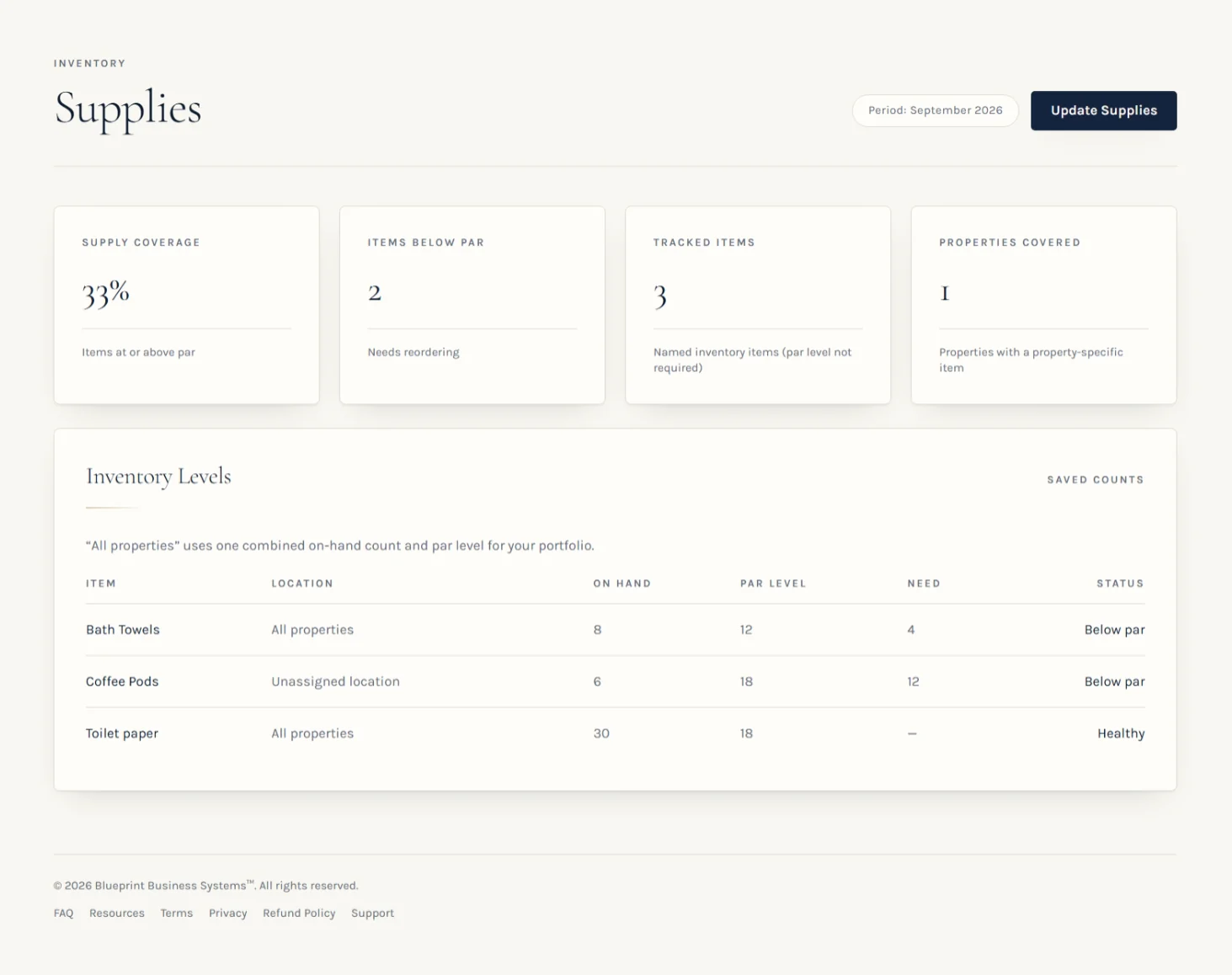
Blueprint approaches this as an operating problem rather than a list problem. During guided setup, an owner records supplies and par levels per property, so the standard is stored against the address it belongs to rather than in a shared file.
Because those standards are recorded in the same system as properties, turnovers, and recorded business information, Blueprint can present supply coverage alongside the rest of the operating picture rather than as an isolated checklist. The Supplies view shows the standards you have recorded for each property, and the Command Center surfaces what needs attention based on the information recorded in the system.
To be precise about what that does and does not mean: Blueprint works from what you record. It does not count physical stock in your property, scan or sense shelves, detect reorders automatically, or connect to a store or supplier to place orders. The value is that your standards, your properties, and your operating information live together, so coverage is visible in the same place you review revenue, expenses, turnovers, and priorities.
That is also why the earlier distinction matters. Recording a target quantity and a par level per property is what lets any operating system — Blueprint or your own spreadsheet — tell you something more useful than 'buy supplies'.
Final takeaway
A good inventory checklist tells you what belongs in the property. A good operating process tells you when that standard needs attention.
Start with the standard, per property, with target quantities and par levels. Split it into what must be verified every turnover and what can wait for a monthly or quarterly audit. Then keep the standard somewhere your cleaner can read it and you can review it — because a checklist nobody can find is the same as no checklist at all.
Keep your standards where the rest of the business lives
Blueprint lets you record property-specific supplies and par levels alongside your reservations, revenue, expenses, and turnovers, so supply coverage is visible in the same operating view as everything else. It is a one-time purchase with no recurring subscription.